

Tile Lift and Relay vs. a New Tile Roof: Which Does Your Roof Need?
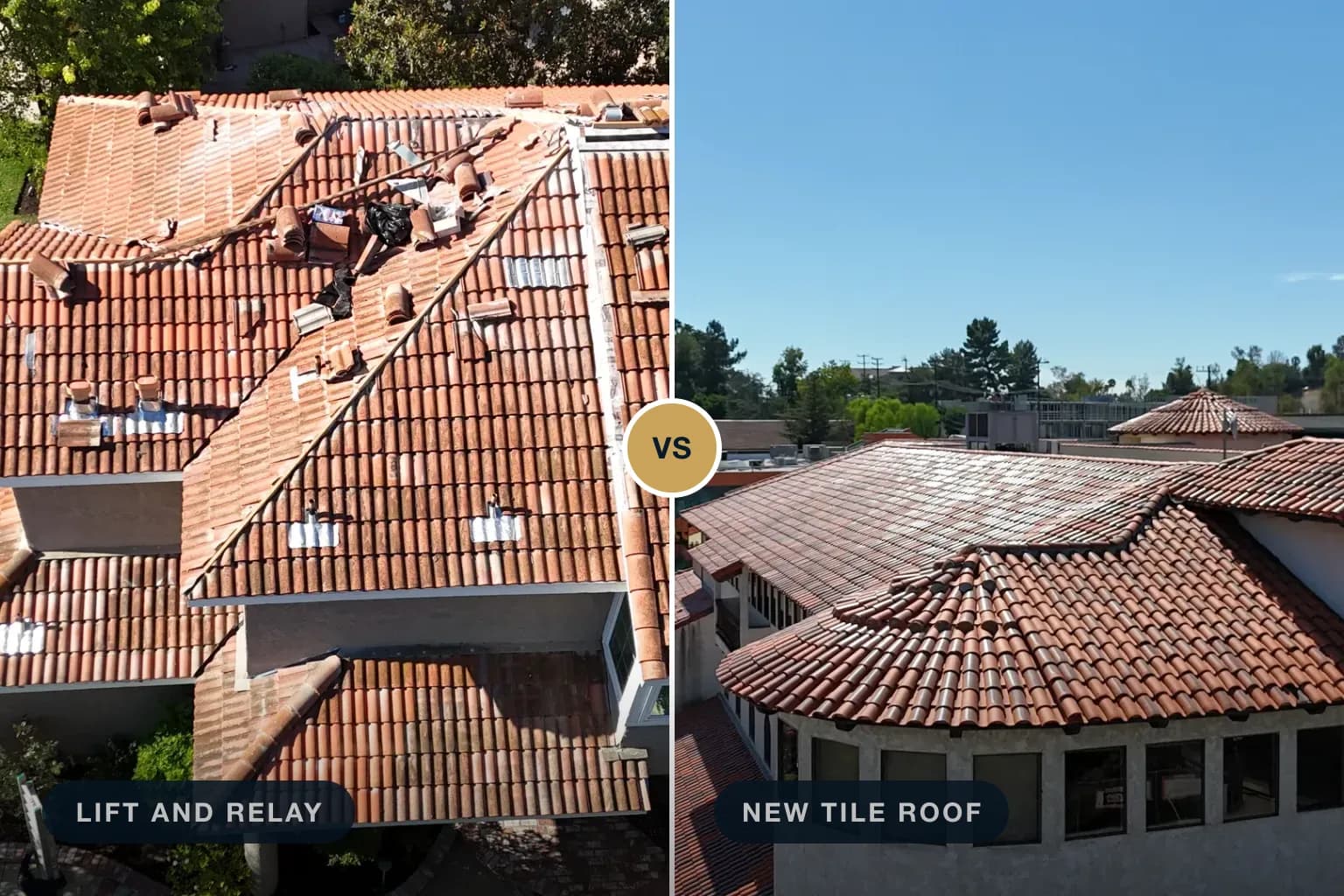
A tile lift and relay and a new tile roof both end with a tile roof that keeps water out. The difference is what happens to your tiles: a relay lifts them off, renews the layers underneath and puts the same tiles back, while a new roof replaces the tiles too.
This guide compares the two, with prices, the signs that point to each and the questions to ask.
Lift and Relay vs. New Tile Roof at a Glance
Why Tile Roofs Leak When the Tiles Look Fine
Clay and concrete tiles can last for decades, but the underlayment that actually keeps water out wears out much sooner. After years of Southern California heat it dries out and cracks, and water that slips past the tiles has nowhere to go but into the deck.
That is why a leak on a tile roof often has no broken tile above it, and why patching tiles does not stop it. Our guide to tile roof underlayment walks through the signs.
How a Tile Lift and Relay Works
A roofer inspects the roof and photographs the underlayment wherever it can be seen, the tiles, the valleys and the flashings.
The tiles come off by hand and are stacked with care
Older tiles sometimes break anyway, so matching replacements are planned from the start.
New underlayment goes down across the roof, and worn battens, flashings and valley metal are renewed as the written scope calls for.
The same tiles go back in their original pattern, with cracked or broken ones replaced by the closest available match.
At QRS this is our SecondLife® Tile Reset. Where a match is not exact, replacement tiles can go on less visible slopes, so the originals stay where people see them.
When a New Tile Roof Makes More Sense
- The tiles themselves are worn. Concrete tile can turn brittle and porous as its surface wears away, and clay can crack after years of foot traffic and shaking.
- Too many tiles are broken or mismatched from years of repairs.
- You want a different look, profile or color.
- The deck or framing needs major work that a relay would not cover.
See tile roof replacement for how a new tile roof is built.
Which Does Your Roof Need?
Which of these sounds most like your roof? Tap a card.
Tile repair
Best when
One area leaks and the underlayment is otherwise sound
What it involves
Fixing the failed spot: slipped or cracked tiles, a flashing, a valley
Tile lift and relay
Best when
The tiles are sound but the underlayment has failed across the roof
What it involves
Lifting the tiles, renewing the layers underneath and resetting the same tiles
New tile roof
Best when
The tiles are worn out, or you want a new look
What it involves
A full tear-off and a new tile roof system
Frequently Asked Questions
Is a lift and relay cheaper than a new tile roof?
Usually, because the tiles are reused. At our Instant Quote ranges a lift and relay is $8 to $11 per square foot of roof, against $12 to $16 for a new tile roof. Your written scope shows the price before any work.
Will my roof look the same after a lift and relay?
That is the point of a relay. Your tiles are reused wherever they are sound, and broken ones are replaced with the closest available match.
How do I know if my tile roof needs a lift and relay?
Common signs are leaks with no visibly broken tiles, ceiling stains after heavy rain, repeated repairs in different spots and underlayment that is brittle or torn where it can be seen. A roof inspection confirms it with photos.
Can concrete tiles be reused in a lift and relay?
Often, yes, as long as they are still sound. Concrete tile whose surface has worn brittle and porous is a reason to consider a new tile roof instead.
Find Out What Your Tile Roof Needs
Book a free roof evaluation. A roofer checks the underlayment, flashings and tiles, shows you the photos and gives you a written scope and price before any work.