

Roofing Terms Glossary — Read any roofing estimate with confidence.
Roofing terms can make an estimate hard to follow. This glossary explains the words roofers use in plain English, from the parts of a roof to the materials, the problems we find and the paperwork, so you can read a scope and ask the right questions.
- Free roof evaluation
- Written price before any work
- 10-year workmanship warranty
- CSLB #1061942
Parts of a roof
- Roof deck (sheathing)
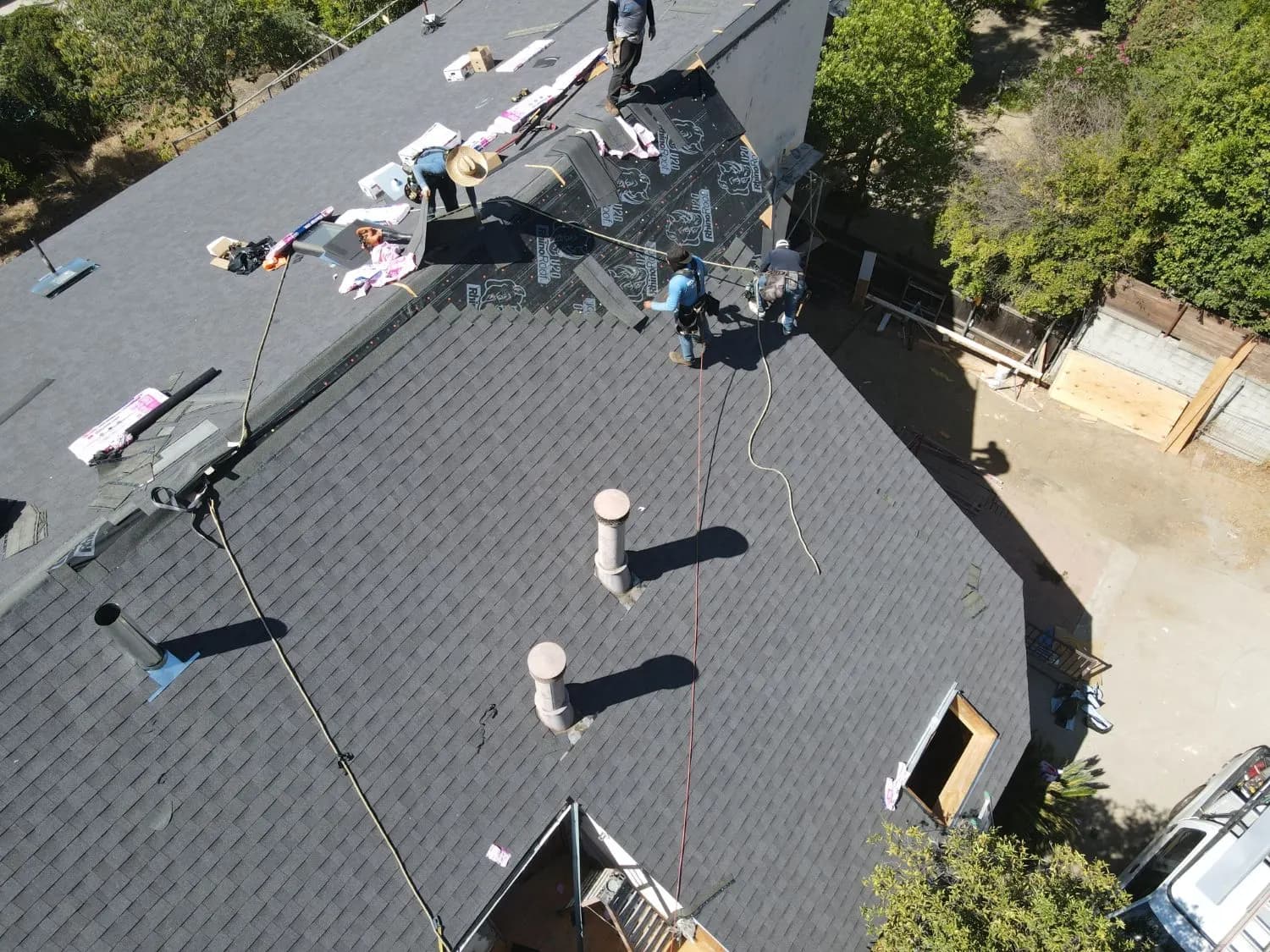
- The layer of plywood or boards fastened to the rafters that everything else is built on. A full tear-off exposes it, so damaged sections can be replaced before the new roof goes on.
- Rafters and trusses
- The wood framing that holds up the roof deck and sets the shape and slope of the roof.
- Underlayment
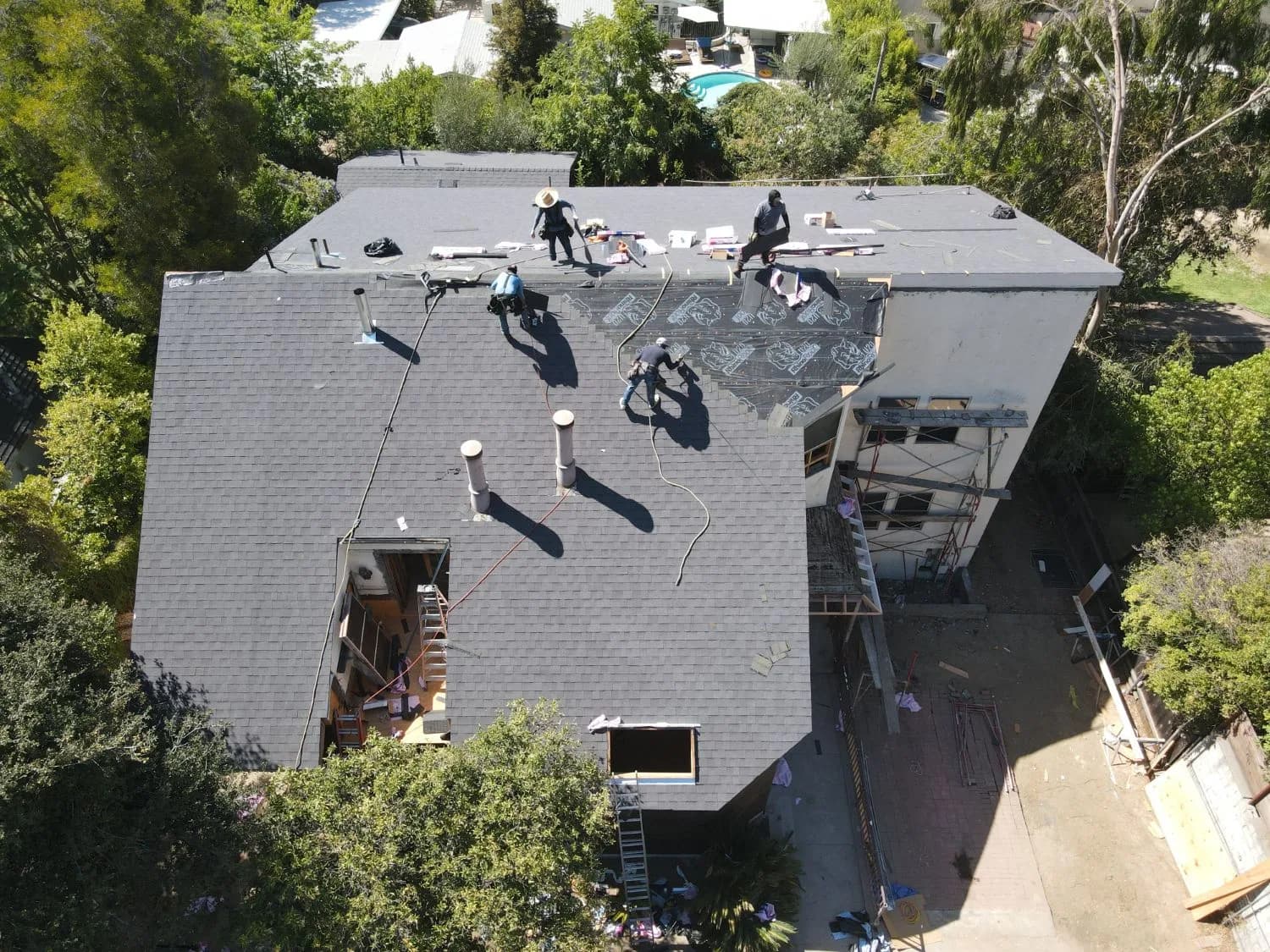
- The water-resistant layer between the roof deck and the shingles, tile or metal. It is the roof’s second line of defense, and on a tile roof it does most of the waterproofing.Read more
- Ridge
- The top edge where two roof slopes meet. It is covered with ridge caps.
- Hip
- The sloped edge where two roof planes meet on the outside of a corner, running from the ridge down to the eave.
- Valley
- The channel where two roof slopes meet on the inside of a corner. Valleys carry a lot of water, so they are a common place for leaks and debris.
- Eave
- The lower edge of a roof that hangs past the wall.
- Rake
- The sloped outer edge of a gable roof, from the eave up to the ridge.
- Gable
- The triangle of wall at the end of a pitched roof. A gable roof slopes down on two sides; a hip roof slopes down on all four.
- Fascia
- The board along the eave that the roof edge finishes against.
- Soffit
- The underside of the eave overhang. Soffit vents let air into the attic.
- Penetration
- Anything that passes through the roof: plumbing vents, exhaust fans, skylights, chimneys, solar mounts or equipment supports. Each one has to be flashed and sealed.
- Parapet
- A low wall that rises above the edge of a flat roof, common on Spanish-style homes and commercial buildings.
- Coping
- The cap along the top of a parapet wall that keeps water out of the wall itself.
- Scupper
- An opening in a parapet wall that lets water run off a flat roof.
- Cricket (saddle)
- A small peaked section built behind a chimney or between slopes to steer water around it instead of letting it pool.
Flashing and details
- Flashing
- Metal or membrane pieces that seal the joints where the roof meets a wall, chimney, skylight, vent or another roof plane. Most leaks start at flashing, not in the middle of a roof.Read more
- Step flashing
- Small L-shaped pieces woven in with each course of shingles where a sloped roof meets a wall.
- Counter flashing
- Flashing set into the wall or chimney that laps over the step or base flashing below it, so water can’t get behind it.
- Drip edge
- A metal strip along the eaves and rakes that guides water off the roof edge and protects the deck’s edge.
- Pipe boot (pipe jack)
- The collar that seals around a plumbing vent pipe. Rubber boots crack in the sun and are one of the most common small leaks on shingle roofs.
- Ridge vent
- A vent that runs along the ridge so warm, moist air can leave the attic.Read more
- Eave closure (bird stop)
- A piece that closes the open ends of the first row of tiles at the eave, keeping out birds, pests and wind-blown embers.
- Battens
- Strips of wood or other material fastened across the roof that some tile roofs hang on.
Measuring a roof
- Square
- Roofers price and order by the square: 100 square feet of roof surface. A 2,000 square foot roof is 20 squares.Read more
- Pitch (slope)
- How steep a roof is, written as the rise in inches for every 12 inches across: a 4/12 roof rises 4 inches per foot. Steeper roofs take more time and safety work.
- Low-slope roof
- A roof that is nearly flat, usually under 3/12. It needs a continuous membrane rather than overlapping shingles or tile.Read more
- Waste factor
- The extra material ordered for cuts, starter rows, hips and ridges, usually given as a percentage of the roof area.
- Roof facet (plane)
- One flat surface of a roof. A simple gable roof has two; a complex roof can have twenty or more, and every extra facet adds cuts, valleys and flashing.
Roofing materials
- Architectural shingle
- A thicker, layered asphalt shingle with a dimensional look. It has largely replaced the flat three-tab shingle on new roofs.Read more
- Three-tab shingle
- A thinner, single-layer asphalt shingle with three flat tabs per strip.
- Starter strip
- The first course of shingles along the eave, which seals the edge and gives the first visible row something to bond to.
- Clay tile
- Fired clay roof tile, the classic Spanish (barrel) or flat profile seen across Southern California. The tile itself can outlast the underlayment beneath it.Read more
- Concrete tile
- Roof tile made from concrete, heavier than clay and made in many profiles and colors.Read more
- Standing seam metal
- A metal roof made of long panels joined by raised seams, with the fasteners hidden under the seams.Read more
- Modified bitumen
- An asphalt roofing membrane strengthened with polymers, laid in rolls on flat roofs. APP and SBS are the two main types.Read more
- Torch-down roofing
- Modified bitumen sheets bonded to the roof by heating them with a torch, so the layers fuse into one waterproof surface.Read more
- Base sheet and cap sheet
- The two layers of a modified bitumen roof: the base sheet goes down first, the cap sheet is the finished, often granulated, top layer.
- TPO
- Thermoplastic polyolefin: a single-ply membrane, usually white, whose seams are welded with hot air. Common on commercial flat roofs.Read more
- Built-up roof (BUR)
- An older flat roof made of alternating layers of asphalt and felt, often finished with gravel.
- Cool roof
- A roof surface that reflects more sunlight and gives off heat more easily than a standard roof, which keeps the roof and the rooms below cooler.Read more
- Class A fire rating
- The highest fire rating a roof covering can get in standard fire tests. Clay and concrete tile, metal and most asphalt shingles can reach it.Read more
Problems we find
- Ponding water
- Water that sits on a flat roof long after rain instead of draining. It wears the surface and finds any weak seam.
- Blister
- A raised bubble in a flat roof membrane where air or moisture is trapped between layers.
- Granule loss
- Asphalt shingles shedding their mineral surface, which leaves the shingle exposed to the sun. Granules washing off the roof and bare, dark patches are signs of an aging roof.
- Nail pop
- A roofing nail that has backed out and lifted the shingle above it, leaving a path for water.
- Slipped tile
- A roof tile that has moved out of place, often because its fastener or the batten under it has failed.
- Wind-lifted shingle
- A shingle whose seal has broken in the wind, so its edge can flap, crease or tear off.Read more
The work and the paperwork
- Tear-off
- Removing the old roofing down to the deck before the new roof goes on, so the deck can be checked and repaired.Read more
- Overlay (re-roof)
- Installing new shingles over an existing layer instead of tearing it off. It hides the deck and adds weight, and the number of layers allowed is limited.
- Lift and relay
- A tile roof repair where the tiles are lifted off, the worn underlayment beneath them is replaced, and the same tiles are put back.Read more
- Scope of work
- The written list of exactly what a roofer will do: materials, details, how damage found during the job is handled and the price. Compare scopes, not just totals.
- Building permit
- Approval from the city or county for the roof work, followed by an inspection. QRS pulls the permits for its jobs.
- Workmanship warranty
- The roofer’s own guarantee on how the roof was installed, separate from the manufacturer’s warranty on the materials. QRS backs its installs with a 10-year workmanship warranty.
- Manufacturer’s warranty
- The material maker’s warranty on its products. The coverage depends on the product and the warranty tier.
- CSLB license
- California’s Contractors State License Board licenses roofers. You can look up any contractor’s license number on the CSLB website before you hire.Read more
Start here
Tell us what you need.
Two minutes. A clear next step. No pressure.
Prefer to answer a few questions instead? Use the step-by-step form
Questions About Your Roof?
Start with a free roof evaluation. A roofer looks at your roof, explains what they find in plain English and gives you a written scope and price before any work.
- CSLB licensed, bonded & insured
- 10-year workmanship warranty
- Google customer reviews
