

How to Find a Flat Roof Leak on a Commercial Building, and Why It’s So Hard to Locate
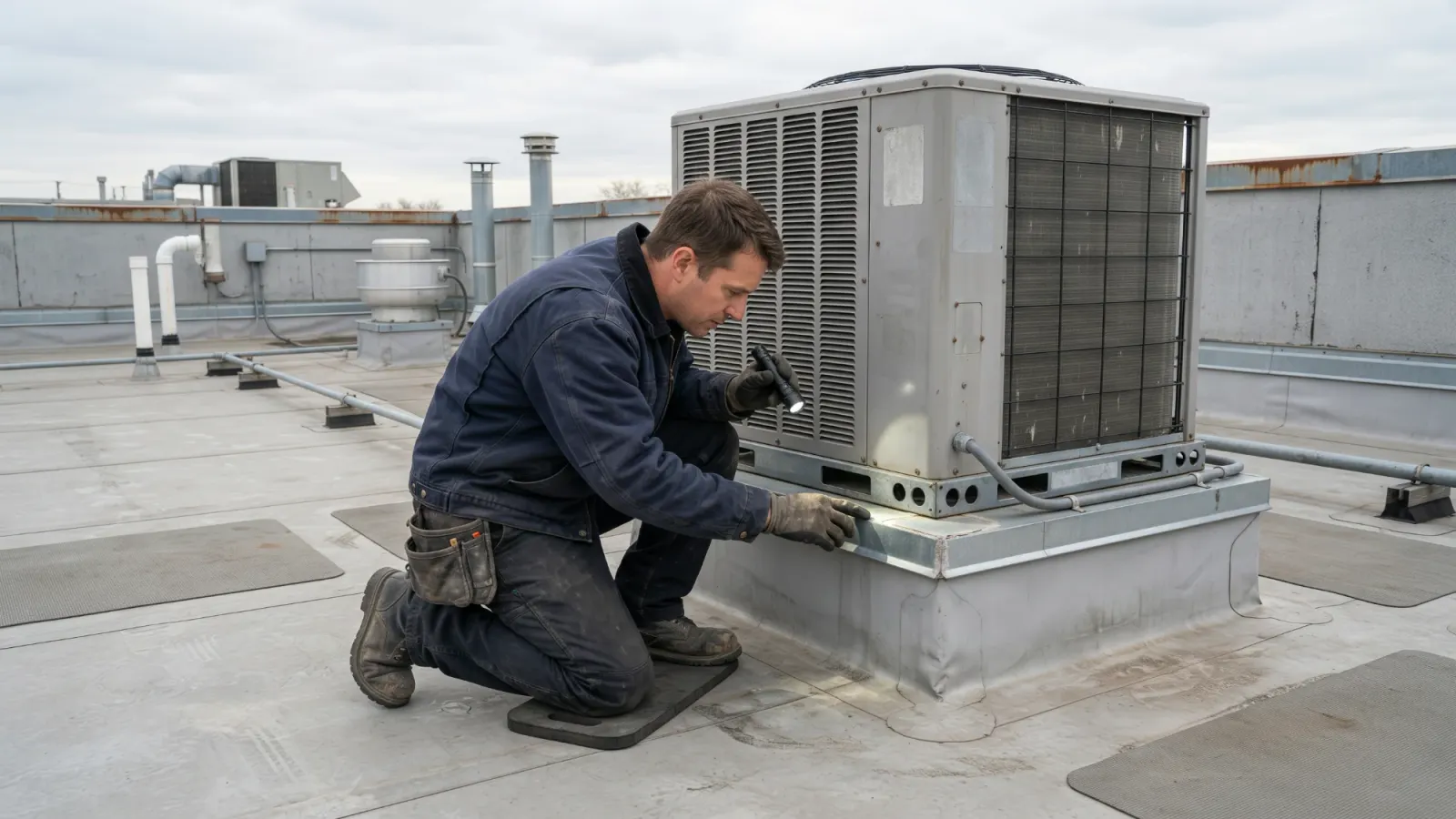
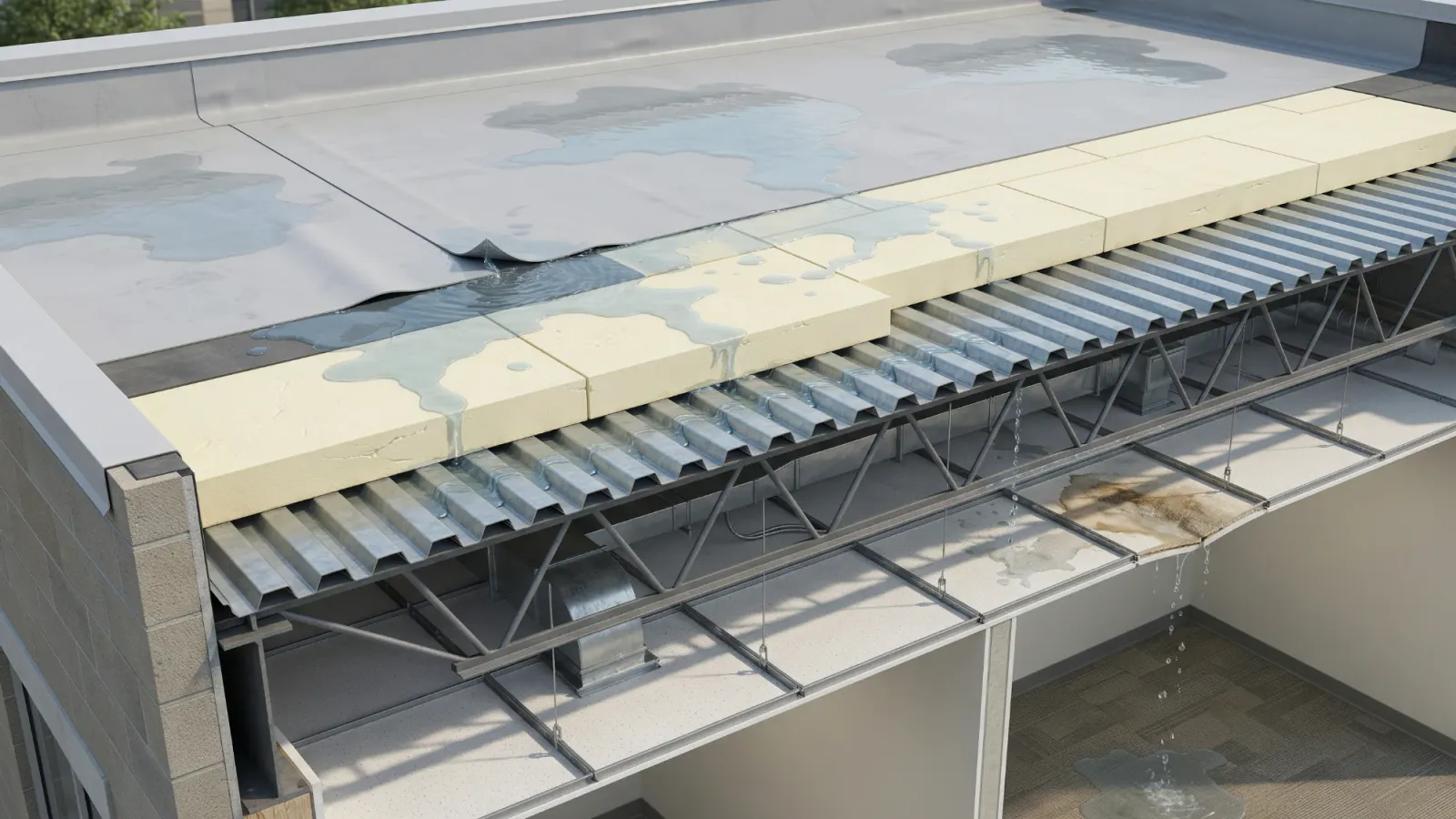
A flat roof leak on a commercial building is one of the hardest leaks to find. Water can get through an open lap or a cracked flashing, run along the deck, the insulation or a seam, and come through a ceiling tile in a tenant’s space well away from where it got in.
This guide is for property managers, owners and building engineers: why the leak is so hard to locate, where it usually starts, what the timing of the drip tells you, how your own staff can log it, and how our roofers trace it to the source.
Why a Flat Roof Leak Is So Hard to Locate
- Water travels under the surface
once it is through the membrane, it runs along the deck, the insulation boards or a seam, following the slope, before it finds a way down.
- The ceiling hides the path
above a drop ceiling, water can run along a beam, a duct or a pipe and drip onto a tile several feet away.
- Big roofs, many details
a commercial roof carries drains, scuppers, parapets, HVAC curbs, vents, skylights and hatches, each one a possible opening.
- Wet insulation holds water
it can keep dripping for days after the rain, which hides when and where the water got in.
- Old roofs are layered
each re-roof over the last one leaves gaps where water sits and moves between layers.
- Other trades walk the roof
service visits to the rooftop units can cut or puncture the membrane far from where anyone looks.
- Old patches hide the evidence
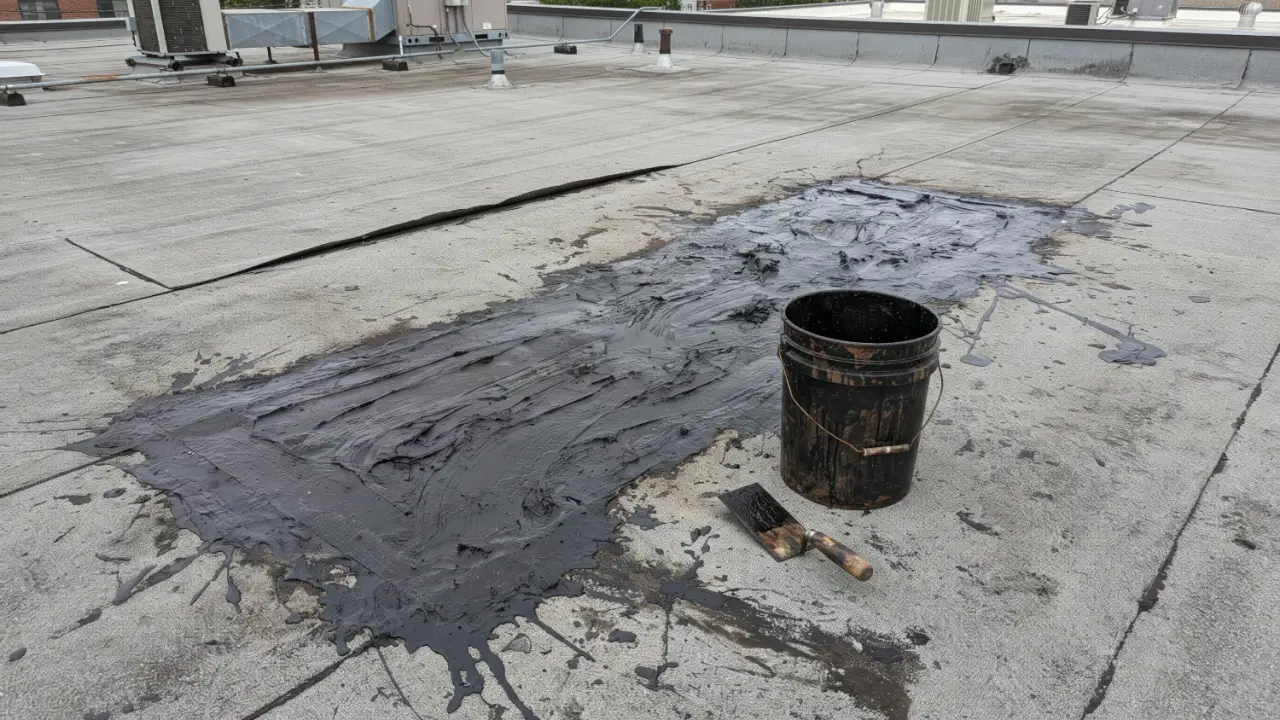
roof cement smeared over a suspected spot can cover the real opening, or move the water a few feet over.
Where Commercial Flat Roof Leaks Usually Start
Most of the flat roof leaks we trace start where the roof meets something, not out in the open field:
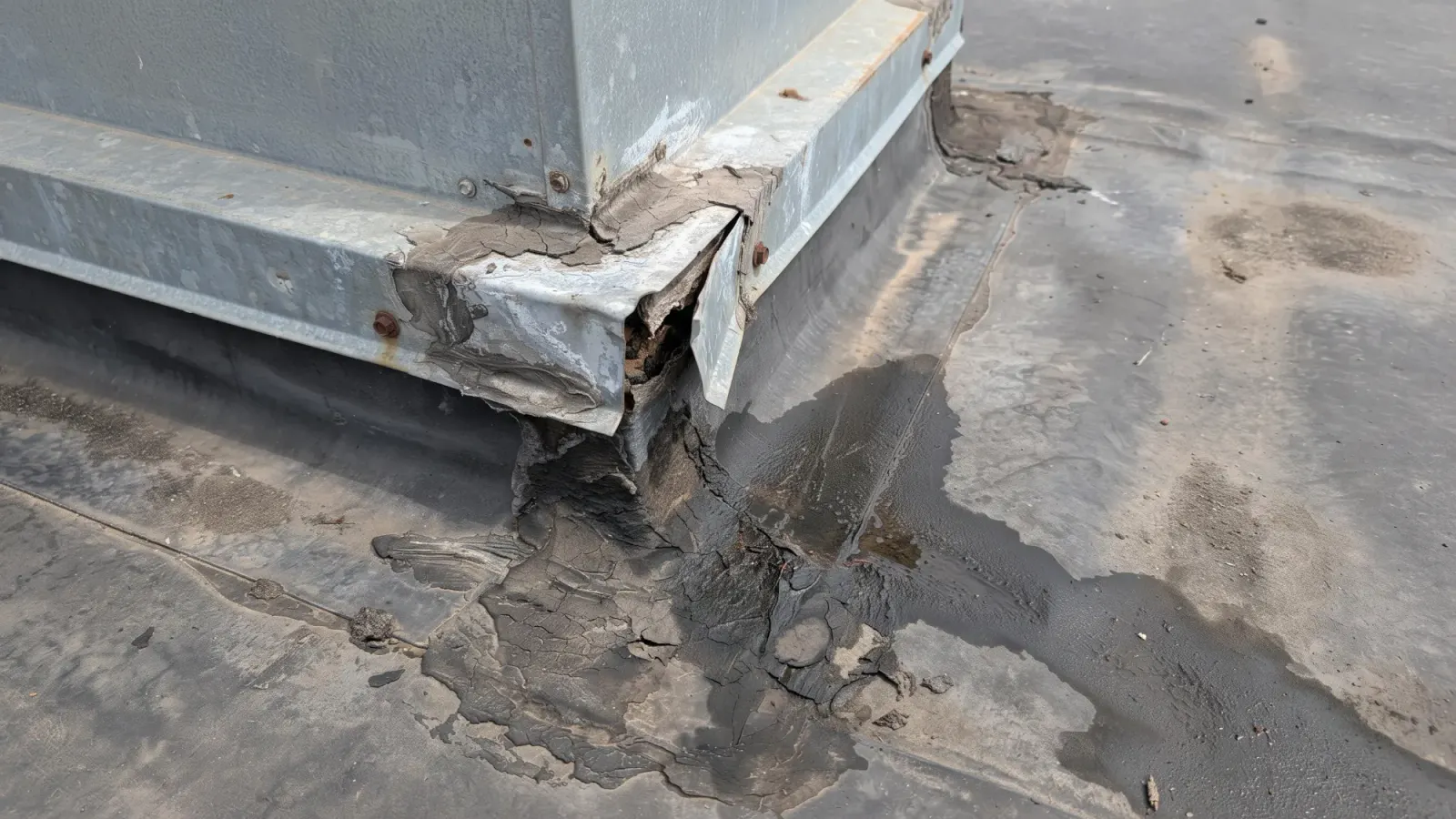
- HVAC curbs: the flashing around the base of each rooftop unit.
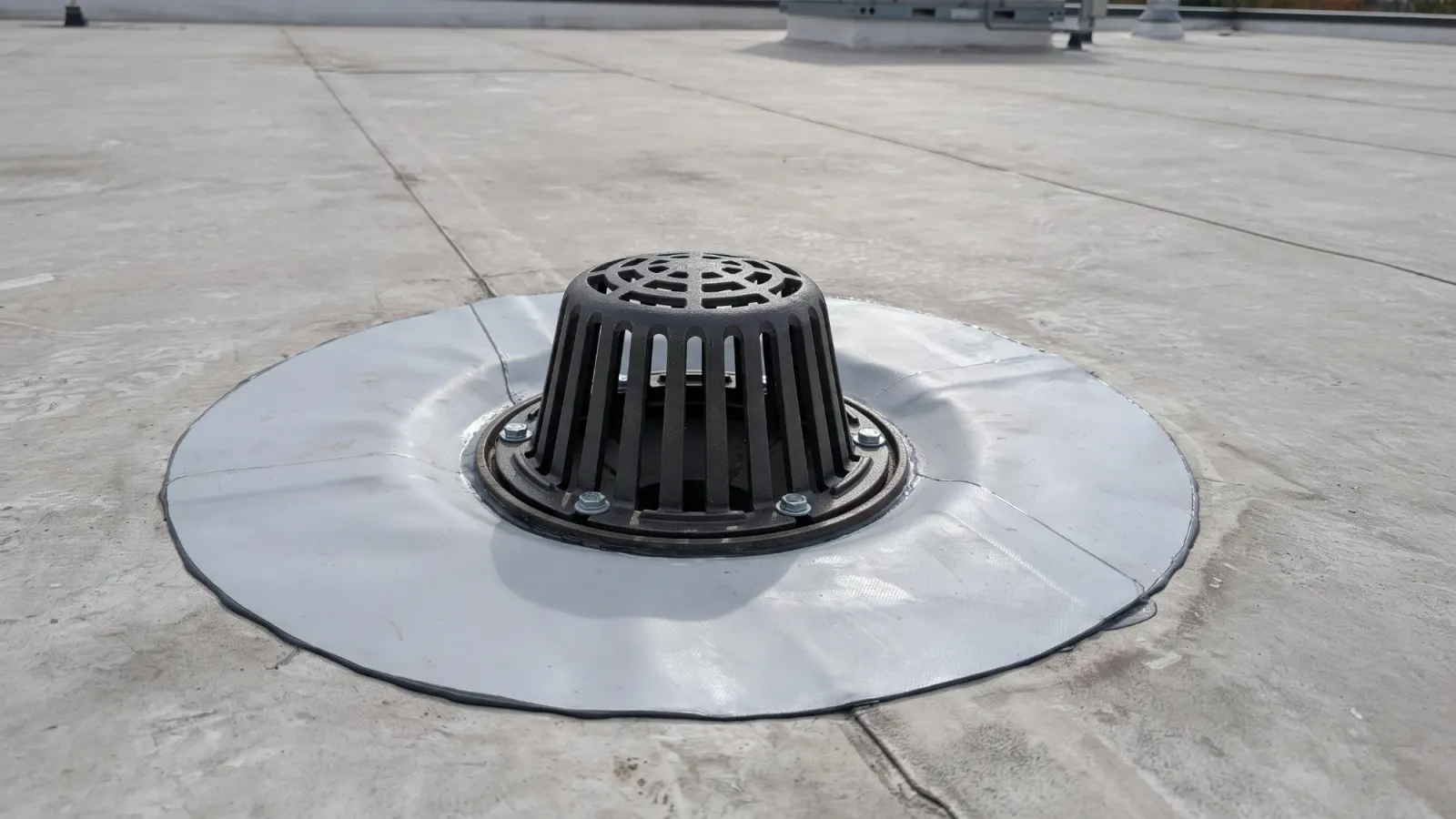
- Drains and scuppers: the flashing around the drain bowl and the scupper box.
- Parapet walls and coping: where the roof turns up the wall and finishes under the cap.
- Vents, pipes, skylights and roof hatches: each needs its own flashing, not just a bead of sealant.
- Laps and seams: where one sheet overlaps the next, especially around low spots.
- Equipment service paths: where foot traffic and dropped tools wear or puncture the surface.
- Ponding spots: where standing water has worn through the surface.
Our guide to ponding water on a commercial flat roof explains why the low spots wear first.
What the Timing Tells You
Before anyone goes up on the roof, note when the drip shows up. It narrows the search more than anything else.
Only in heavy rain
- What it often points to
- Water backing up at a drain or a scupper, or a pond reaching an open lap
- Where to look
- The outlets and the low spots around them
When rain comes with wind
- What it often points to
- Water driven sideways at the edges
- Where to look
- Parapet coping, wall flashing and edge metal
Every rain, in the same spot
- What it often points to
- An opening close to that spot
- Where to look
- Seams, curbs and penetrations upslope of the stain
Days after the rain stops
- What it often points to
- Water trapped in the insulation or between layers
- Where to look
- A wider area upslope; the roof may be wet in more than one place
Right after a rooftop unit was serviced
- What it often points to
- A cut, a puncture or a loosened panel from the visit
- Where to look
- The service path and the unit’s curb
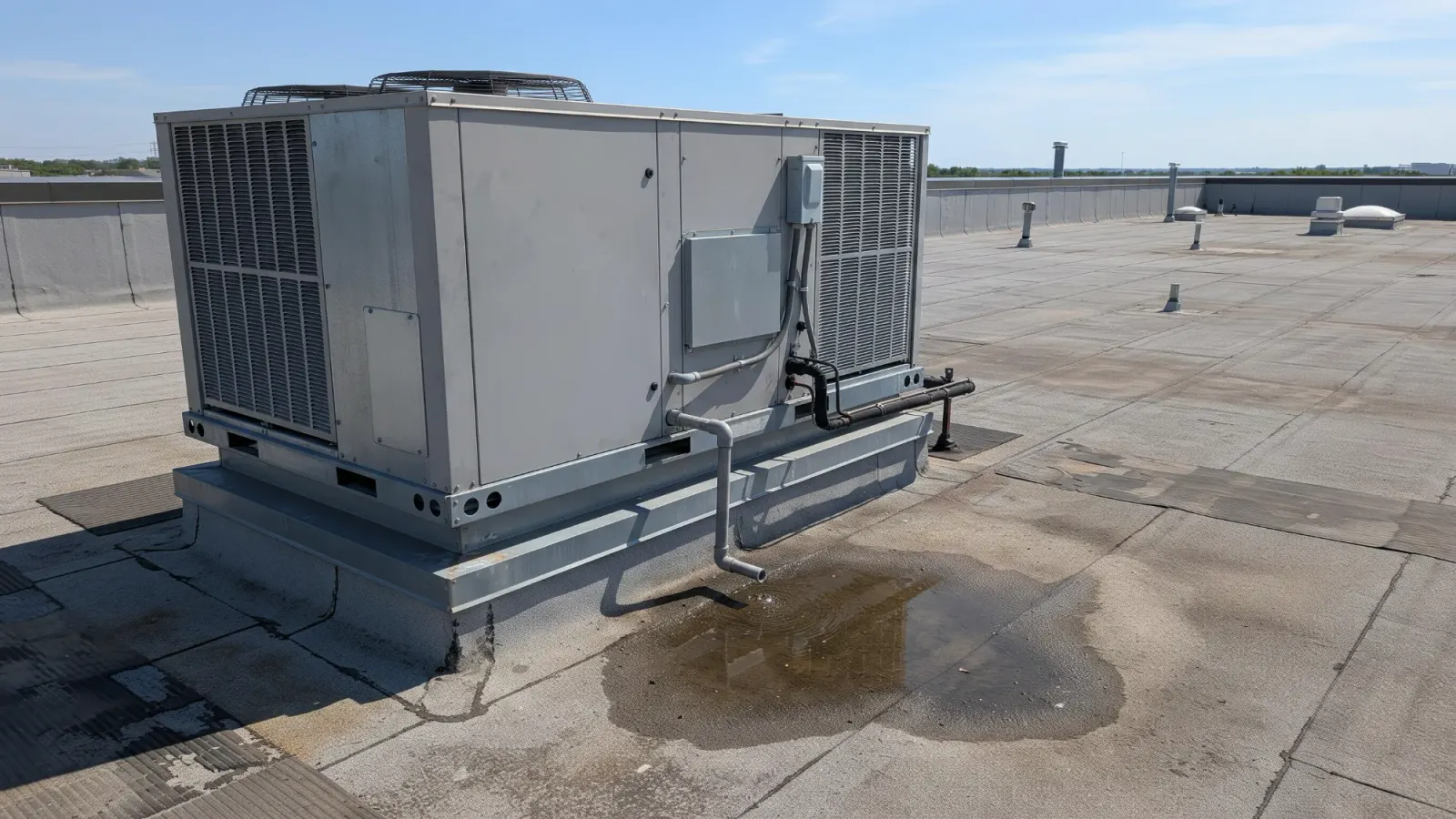
Under a rooftop unit, even on dry days
- What it often points to
- Often the unit’s condensate drain line, not the roof
- Where to look
- Call your HVAC contractor first
Keep a Leak Log Your Roofer Can Use
Log every report. The date, the weather, the suite or room and what the tenant saw: a stain, a drip or water on the floor.
Mark it on a plan. Put each leak on a simple floor plan and, if you have one, a roof plan. A pattern usually shows up after two or three storms.
Look above the ceiling. Lift the wet ceiling tile and look with a flashlight for where the water runs along a beam, a duct or a pipe. Photograph it.
Measure to the walls. Measure from the wet spot to two outside walls, so the same spot can be found on the roof.
Note what changed. Recent HVAC service, a new antenna or solar mount, or other trades on the roof are all worth writing down.
Keep people out from under it. Catch the drip, move what can be damaged and cordon off a sagging ceiling.
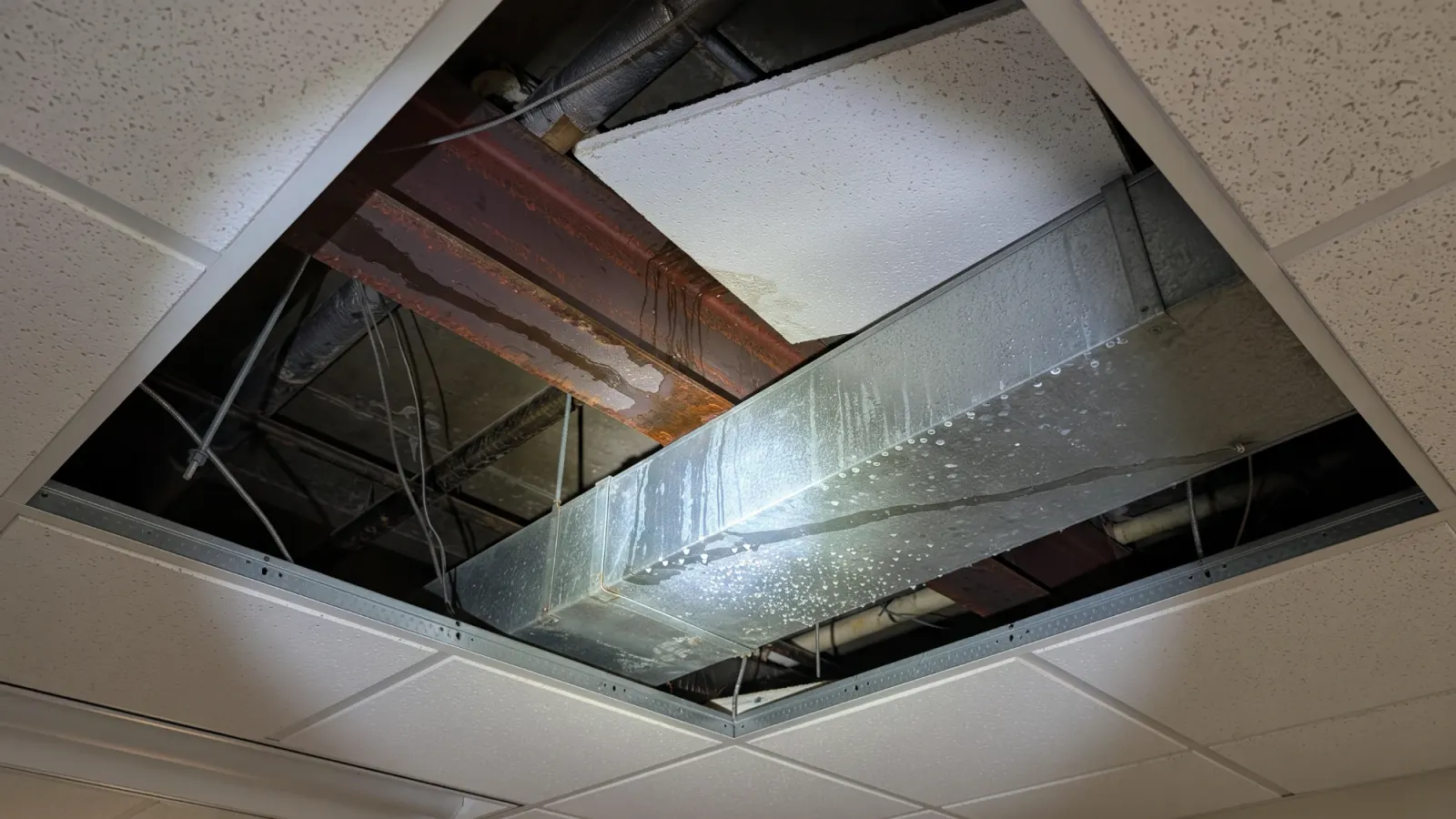
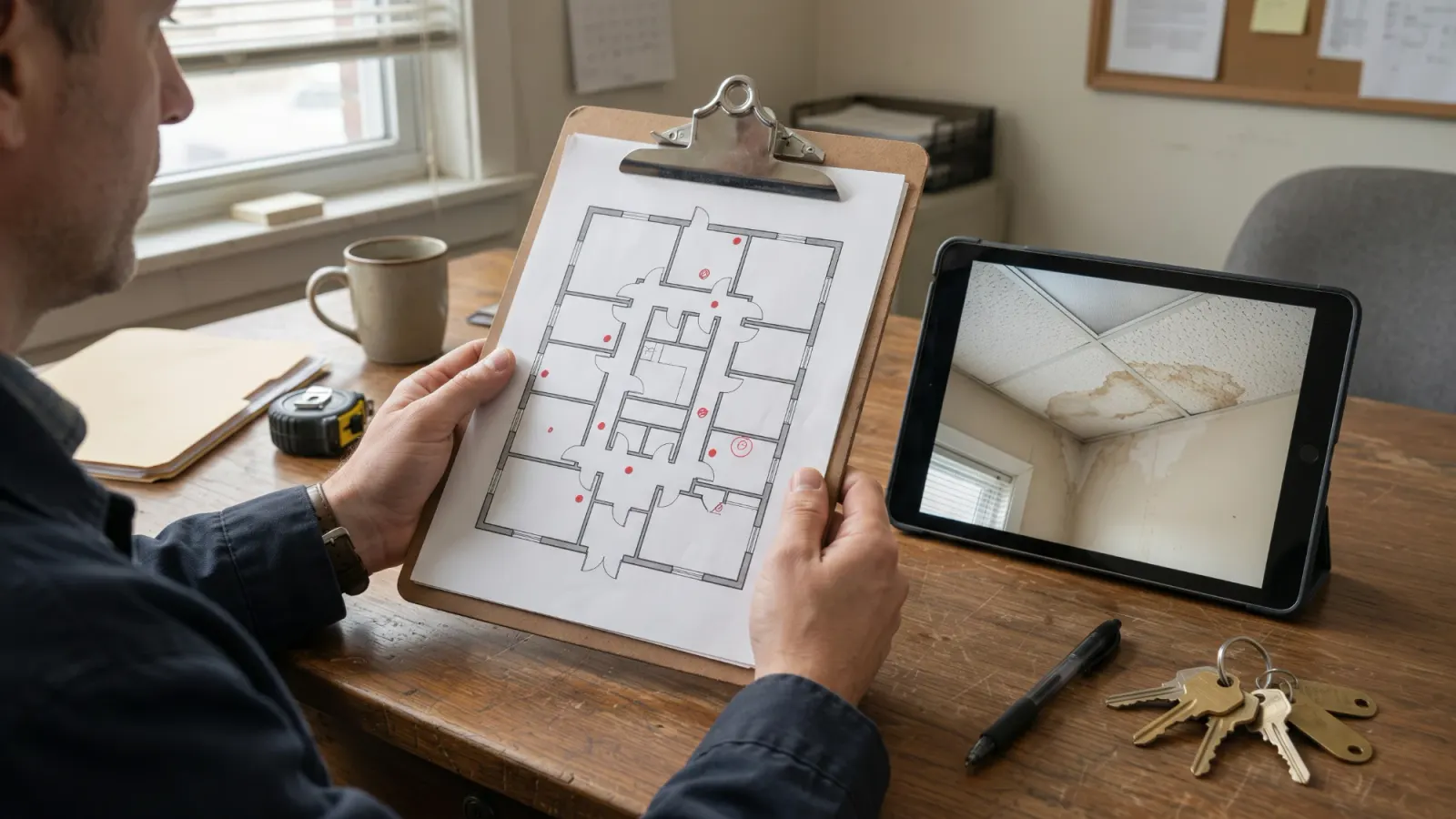
A good log turns a search of the whole roof into a search of one area. It is the most useful thing your staff can hand us.
What Not to Do
Don’t have staff smear roof cement over the area above the stain. It rarely finds the opening and makes the next search harder.
Don’t pop a blister to see if it is wet. It opens a new hole.
Don’t send anyone onto a wet roof, especially over the leak.
- Don’t assume a patch fixed it
Watch the next rain, and keep logging.
- Don’t ignore a sagging ceiling
It can come down; keep people out from under it.
How Our Roofers Trace a Commercial Flat Roof Leak
Start with your log. The dates, the weather and the spots on the plan tell us where to begin.
Look inside first, when it helps. Seeing where water shows up inside helps us trace it, so we may ask to look at a ceiling or the area under a drain, arranged with you ahead of time.
Work upslope on the roof. A roofer checks every detail in the water’s path: seams, curbs, vents, drains, scuppers, parapets and hatches.
Photograph it. You get photos of the source, and of any earlier patch that didn’t hold, ready to share with the owner or the tenant.
Prove the source. When it isn’t obvious, a water test one section at a time, from the bottom up, shows which spot lets water in before anything is repaired.
Give you one next step, with a written scope and price before any work.
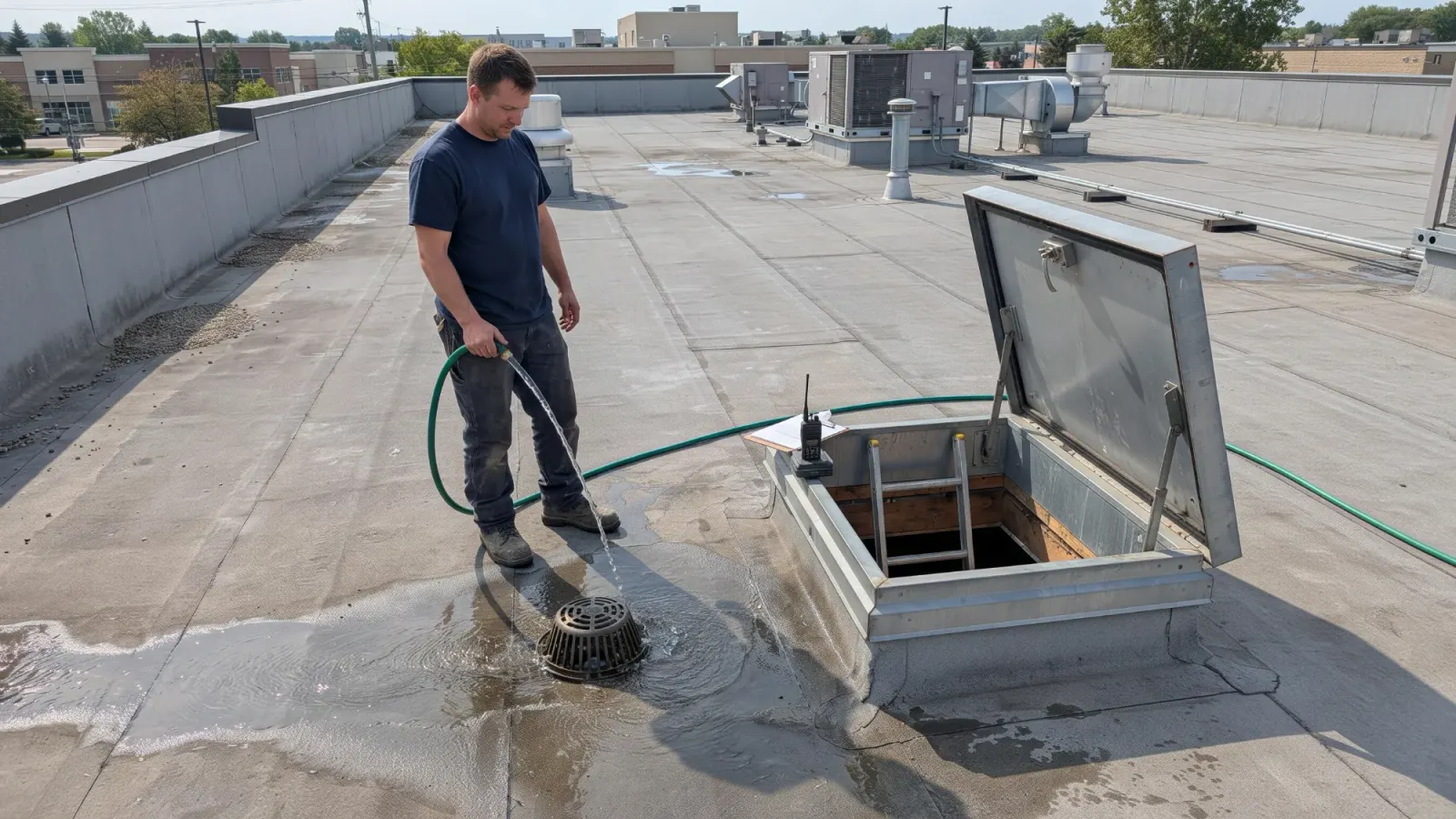
When the opening is one detail, a commercial roof repair fixes it at the source while the building stays open. If the blockage is deeper in a drain line, we tell you so a plumber can clear it. When water has spread through the roof, a commercial roof replacement is phased section by section. On a commercial building in Westminster, the roof came off down to the deck and new plywood went in where the deck needed it.
To keep the next one from starting, scheduled commercial roof maintenance clears drains and checks flashings, with a photo report every visit. Our article on commercial roof leak repair goes further into the repair itself.
Frequently Asked Questions
Why is a flat roof leak so hard to find?
Water can get under the surface and travel along the deck, the insulation or a seam before it comes through the ceiling, often well away from where it got in. Above a drop ceiling it can run along a beam or a duct too, and old layers and patches hide the evidence.
Can a flat roof leak be far from the wet ceiling tile?
Yes. The tile shows where the water came through the ceiling, not where it got into the roof. The opening is usually upslope of it, toward the high side of the roof.
Why does our flat roof leak only in heavy rain?
Light rain drains away before it finds a weak spot, but heavy rain deepens the water on the roof and pushes it into open laps, cracked flashings and overflowing drains and scuppers. A roof survey pinpoints which one it is.
Is the water under our rooftop unit a roof leak?
Not always. A clogged or disconnected condensate drain line can drip on dry days, and that is for your HVAC contractor. If it only shows up in rain, the flashing around the unit’s curb is a common source.
What should our maintenance staff do when a tenant reports a leak?
Catch the drip, protect what is below it, log the date, the weather and the location, look above the ceiling tile and photograph it, then call a roofer. Leave the roof itself to the roofer.
Can the leak be fixed while the building stays open?
Usually, yes. Most repairs happen on the roof, and any interior visit is arranged with you ahead of time. Larger work is phased so tenants keep working.
Chasing a Leak on a Commercial Roof?
Request a roof survey. A roofer traces the leak from your log to the source, photographs it, and gives you a plain-English answer and a written scope and price before any work. Or call (310) 340-1643.
For homes, see our guide to finding a roof leak.
