

How to Vet Commercial Roofing Near Me: Questions, Red Flags and What to Expect From a Roofer-Led Inspection
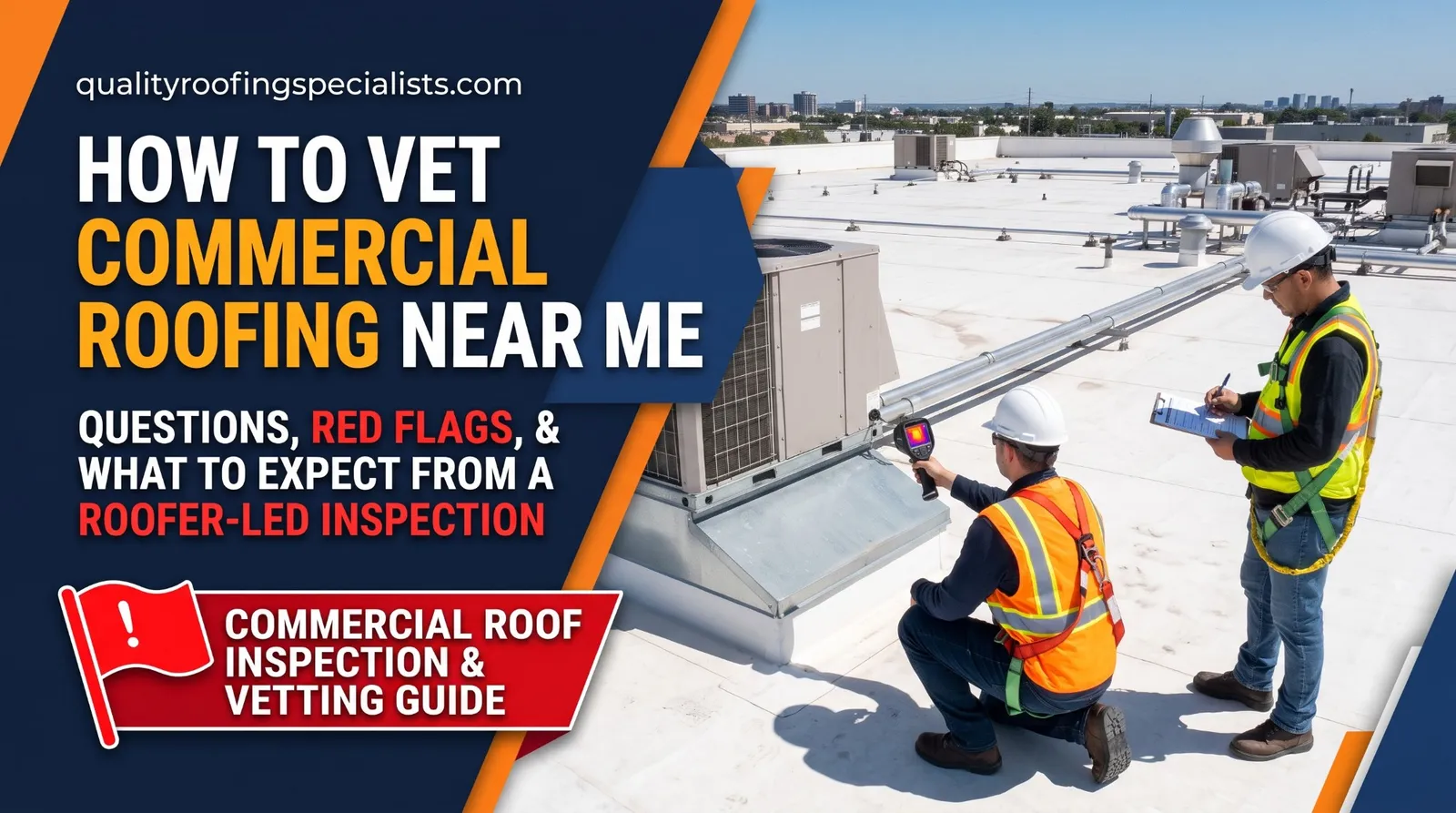
When you search for commercial roofing near me, four things separate a qualified roofer from a liability: a roofer-led inspection with documented findings, a written scope before any price, credentials you can verify yourself, and materials matched to your roof and named in writing. Those four are the filter, and this guide shows how to apply them, whether you manage an office building in Los Angeles, a retail center in Orange County or a warehouse in the Inland Empire.
We are commercial roofers ourselves, so this is written from the roof: what a real inspection looks like, the credentials to check, how to read a flat roof proposal, the questions to ask at the walkthrough, and the red flags that should end the conversation. For more on choosing between companies, see our guides on how to choose a commercial roofing contractor and choosing a commercial roofing company in Los Angeles.
Key Takeaways
- The inspection comes first. A roofer-led survey with drone footage, photos and written findings should come before any talk of price.
- Verify the credentials yourself. Check the license on the CSLB website and the insurance with the insurer, not just the proposal.
- The materials are named. A real proposal names the system, the membrane and its thickness, the insulation and the flashing details, not just “flat roof replacement.”
- Compare equal scopes. Two bids for the same roof can be far apart because one leaves out the tear-off, insulation or drains.
- Some red flags are disqualifying: no verifiable license, a large deposit up front, a verbal-only warranty or a one-page proposal with no detail.
What a Real Commercial Roof Inspection Includes
The first thing to find out is whether the person on your roof is a roofer or a salesperson. A roofer understands drainage, membrane failures and the details around equipment; a sales visit is built to close a contract. The difference shows in what you get afterward: a roofer’s inspection produces findings, a sales visit produces a proposal.
A thorough commercial roof inspection should give you:
- Drone footage of the whole roof: the field, the membrane and the perimeter
- Close-up photos of failing seams, flashings and penetrations
- The drainage: slope, drains, scuppers and any ponding
- HVAC curbs, vents and other penetrations
- Parapet walls, coping and edge metal
- Inside the building, the stains or damp areas if there are active leaks
- Written findings in plain English, before any price
A contractor who skips the inspection and quotes from the square footage alone isn’t taking a shortcut; that’s a red flag. Our commercial roof inspection checklist goes through the points in more detail.
The Credentials to Verify Before You Sign
In California, a roofing contractor needs an active license from the Contractors State License Board. Don’t take the proposal’s word for it: use the CSLB’s Check A License to confirm the license is active, carries a roofing classification, matches the business name on the contract and shows no disciplinary actions.
On insurance, ask for certificates for general liability and workers’ compensation and confirm them with the insurer directly, using contact details you find yourself. Ask your own insurance advisor what limits your building needs, and whether to have your property named as an additional insured.
Two Warranties, Both in Writing
The manufacturer’s warranty covers the materials. The contractor’s workmanship warranty covers the installation, and installation is where many roof problems start, so it deserves as much attention as the product. Ask for both in writing, with what they cover and how a claim works; our article on roof warranties explains the difference.
For our part: Quality Roofing Specialists is licensed, bonded and insured (CSLB #1061942), accredited by the BBB with an A+ rating, and our installs carry a 10-year workmanship warranty (call for details). The details are on our credentials page.
TPO vs. Modified Bitumen: Reading a Flat Roof Proposal
A legitimate commercial flat roof proposal names the system, the materials and the construction details. You don’t need to be a roofer to read one, but knowing the two most common low-slope systems in Southern California helps you ask the right follow-up questions.
TPO is a single-ply membrane whose seams are welded with hot air into one continuous sheet, usually white to reflect the sun. Modified bitumen is a multi-layer, asphalt-based system reinforced with polyester or fiberglass, installed torch-applied, cold-applied or self-adhered, often with a white granulated cap sheet.
| Factor | TPO | Modified bitumen |
|---|---|---|
| Seams | Hot-air welded into a continuous sheet | Overlapping plies, sealed by torch, adhesive or self-adhered laps |
| Surface | White and reflective | Granulated cap sheet; reflective white cap sheets are available |
| Foot traffic | Walk pads recommended where equipment is serviced | Multiple plies tolerate rooftop traffic well |
| Installation | Adhered or fastened, no open flame for the membrane | Torch-applied, or cold-applied and self-adhered where a flame isn’t right |
Which one is right depends on the building: its drainage, its equipment, how often people are on the roof and what’s on it now. Our TPO roofing page and our comparison of torch-down APP vs. SBS go deeper. Whatever the system, a proposal should spell out the tear-off, the deck, the insulation, the membrane, the flashings, the edge metal and the drains by name, not bundle them into one line.
Questions to Ask at the Estimate Walkthrough
The walkthrough is your best chance to find gaps in the scope and test the roofer. Start with the basics: is this a repair, a recover or a full tear-off? If damaged decking is found during tear-off, how will it be priced? Are the flashings, edge metal, drains and curbs included, or excluded from the base price?
- How is deck replacement priced if damage is found during tear-off?
- Are drains, edge metal and pipe boots included, or separate line items?
- What is the payment schedule, and what is each payment tied to?
- How are change orders approved and documented?
- Which permits and inspections are included in the price? (Our guide to roofing permits in Los Angeles covers the local departments.)
- How will the work be scheduled around tenants, customers or staff?
Before you sign, confirm what you get at the end: the manufacturer’s warranty, the workmanship warranty in writing, the permit records and closeout photos. Ask how a warranty leak is reported and handled, and whether maintenance is required to keep the coverage. A contractor who resists putting any of this in writing usually has a reason.
What Moves the Price, and Comparing Bids
We don’t publish prices in our articles, because a commercial roof’s price depends on that roof: its size and access, how many layers come off, the condition of the deck and insulation, the drains and edge details, the equipment on it, and whether the building stays occupied while the work is phased. A commercial roof repair of one failed area is a very different job from a full commercial roof replacement.
The lowest bid is rarely the best value when it leaves out flashings, decking or warranty terms. A comparison only means something when the scopes match: the same materials, the same included items, the same warranties and the same way of handling what’s found under the old roof.
How the Right Roofer Protects Your Operations
A good commercial roofer plans the noisy and disruptive work around your schedule, not theirs: phased tear-off, start times that suit your tenants or customers, staging that doesn’t block entrances, and a written schedule before work begins, agreed with the people who will actually be on site. Our page for property managers describes how we plan work around tenants.
Communities and multi-family buildings need more coordination still. Our ReserveReady® program for HOA and multi-family properties gives boards and managers one point of contact, photo-documented reports for board records and work phased building by building.
And leaks don’t wait for a replacement schedule. When water is coming in, we take emergency roof repair calls after hours and on weekends and put tarps in place when they’re needed, with photos for the insurance file. A roofer who can respond like that is worth knowing before the storm.
Frequently Asked Questions
What should I look for when searching for commercial roofing near me?
A roofer-led inspection with photos and written findings, a written scope before any price, a California license and insurance you can verify yourself, materials named in the proposal, and both warranties in writing.
How often should a commercial roof be inspected?
Many owners schedule an inspection at least once a year and after major storms, so drainage, flashing and penetration problems are caught early. Our commercial roof maintenance plans put those visits on a schedule, with photo reports.
Who handles the permits, and should they be in the bid?
The licensed contractor usually pulls the permit. The bid should say which permits and inspections are included, or list them as exclusions, so you can compare bids on equal terms. We pull the permits on our jobs.
What does your commercial roof survey include?
Our commercial work starts with a roofer-led roof survey: drone footage, photos and a written scope and price before any work. Request a roof survey and we’ll explain what it includes for your building.
Do you work on HOA and multi-family roofs?
Yes. Our ReserveReady® program gives HOA and multi-family properties one point of contact, photo-documented reports and work phased building by building.
The Right Contractor Clears Every Bar
The right commercial roofer leads with a roofer-led inspection, puts the findings and the scope in writing before the price, holds credentials you can verify, names the materials and has a plan for protecting your operations during the job. Those aren’t premium features; they’re the baseline, and a contractor who can’t meet all of them is a risk, not a bargain.
We serve commercial property owners and managers across Los Angeles County, Orange County and the Inland Empire, from commercial roofing repairs to full replacements, and every job starts with a roofer on your roof, not a salesperson with a clipboard. Request a roof survey to get started.
