
What Is the Most In-Demand Type of Commercial Roofing?
Add QRS as a preferred source on Google (opens in a new tab)
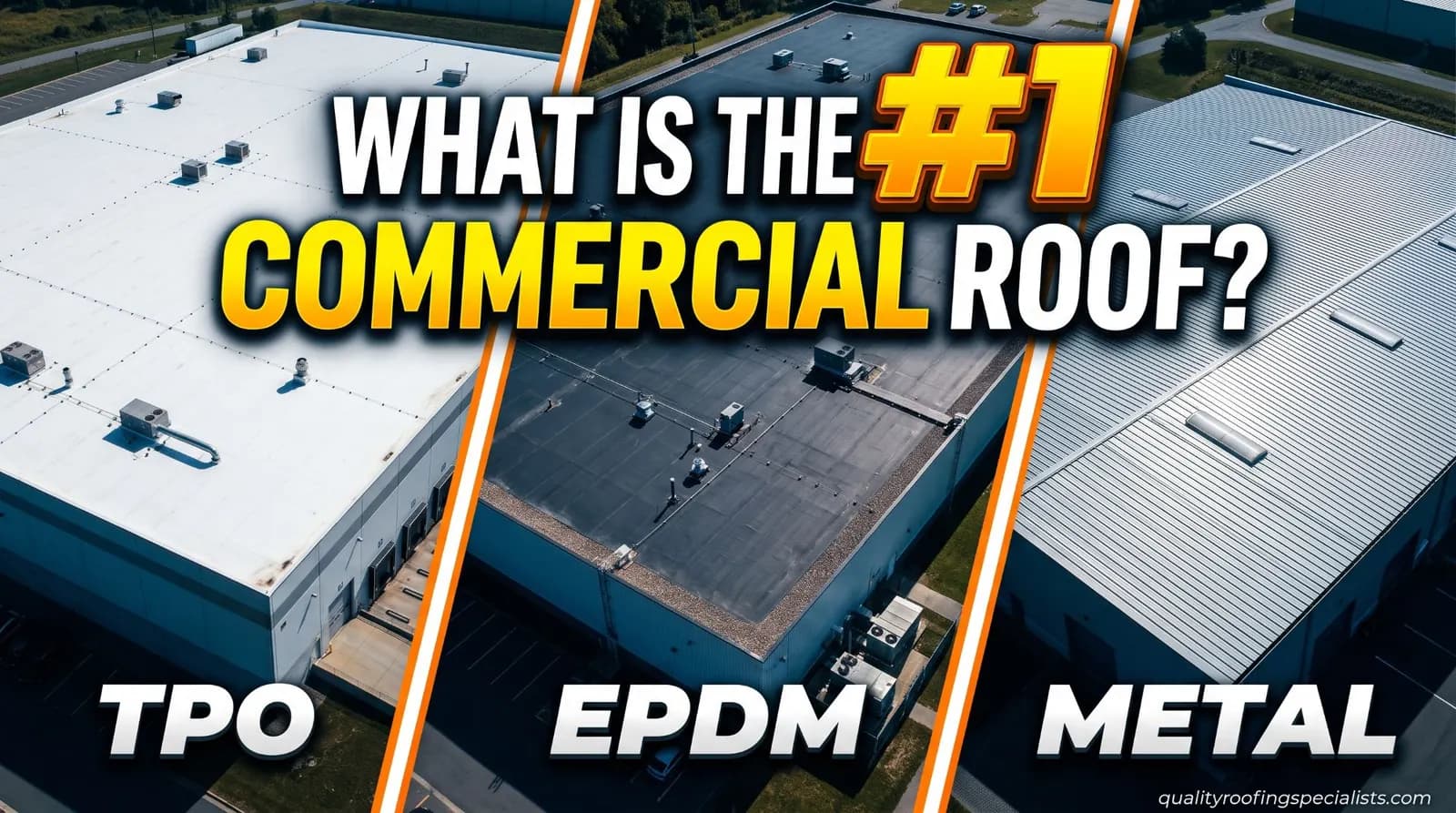
If you ask which type of commercial roofing is in the most demand right now, the industry surveys give a clear answer: TPO, the white single-ply membrane you see on warehouses, offices and shopping centers.
It is not a landslide, though. PVC and EPDM still hold big shares of the flat-roof market, and most commercial roofing contractors also work with metal.
Here is what the latest numbers show, why TPO keeps coming out on top, and how to tell whether the most popular roof is the right one for your building.
The Short Answer: TPO Leads, by a Clear Margin
Two recent surveys look at the market from different angles, and both put TPO first.
In Roofing Contractor magazine’s 2025 Commercial Roofing Trends Report, about 37% of commercial contractors named TPO as their chief product, ahead of PVC at 28% and EPDM at 24%. The year before, just under half named TPO.
In the western half of the country, Western Roofing’s 2025 low-slope market report puts TPO at 36.7% of low-slope roofing, up slightly from 36.5% a year earlier and still the top system. All single-ply membranes together (TPO, PVC, EPDM and CPE) make up 51.1%.
What the Numbers Measure
The surveys don’t count the same thing, so it helps to read them side by side.
| Survey | What it measures | What it found |
|---|---|---|
| Roofing Contractor, 2025 Commercial Roofing Trends Report | The product commercial contractors call their chief one | TPO 37%, PVC 28%, EPDM 24% (TPO was 49% the year before) |
| Roofing Contractor, same report | How many contractors work with metal | 75% are involved with metal roofing; it averages 15% of their revenue, second only to single-ply |
| Western Roofing, 2025 low-slope market report (western U.S.) | Share of low-slope roofing | TPO 36.7%, all single-ply 51.1%, all modified bitumen 20.6% |
Read together, they say the same thing: TPO is the system most commercial roofs get today, and single-ply membranes as a group cover about half of all flat roofs. The drop from 49% to 37% in the contractor survey shows PVC gaining ground, not TPO losing its lead.
Why TPO Became the Default
It reflects the sun
A white TPO membrane reflects much of the sun’s energy instead of soaking it up, so the roof surface runs cooler. On a large building in a warm climate, that matters to the people and equipment underneath.
It helps meet cool roof rules
California’s Title 24 energy code includes cool roof requirements for many low-slope commercial roofs, and a reflective membrane is one way to meet them. Our guide to cool roofs explains how they work.
Welded seams
TPO seams are fused with hot air, so a well-made seam becomes one continuous sheet. Wide rolls also mean fewer seams across a big roof.
It fits most flat roofs
It can be fastened, fully adhered or ballasted, so it suits many decks and building types. Freedonia’s roofing research describes TPO as a key volume driver because it fits the broadest range of standard low-slope roofs.
Where EPDM Still Fits
EPDM is a synthetic rubber membrane, usually black, and it has been on commercial roofs for decades. About a quarter of commercial contractors still call it their chief product.
Building owners and contractors know it well, and it is flexible. The tradeoff in a sunny climate is color: a black roof absorbs heat that a white one would reflect, so a standard black EPDM roof is a harder fit for cool roof rules. Its seams are glued or taped rather than welded, so seam work is where an EPDM roof needs the most care.
Where Metal Fits
Metal is a different kind of roof. It goes on sloped roofs, not dead-flat ones, which is why you see it on metal buildings, warehouses with pitched roofs and many newer commercial designs.
Three out of four commercial contractors in the 2025 survey work with metal, and it is the second-largest source of their revenue after single-ply. Industry forecasts expect standing seam to stay the largest part of the metal market.
If your building has a flat or low-slope roof, metal usually isn’t the comparison to make. If it has real slope, metal may belong on the shortlist.
Popular Isn’t the Same as Right for Your Building
The survey numbers tell you what most buildings get. They don’t tell you what yours needs. The right system depends on things only a look at the roof can answer:
- How much slope the roof has, and how well it drains today.
- What is on the roof: HVAC units, kitchen exhaust, solar, foot traffic.
- What the building vents onto the roof, since grease and oils affect some membranes more than others.
- Whether the existing roof can stay or needs a full tear-off.
- What the energy code asks of this building.
- How the work can be phased so the building stays open.
At Quality Roofing Specialists, a roofer surveys the roof first, then we recommend the system that suits the building, with photos, a written scope and a price before any work begins. For many of the flat commercial roofs we see, that is TPO roofing, and sometimes it is a modified bitumen (torch-down) system; our guide to TPO pros and cons compares the two.
Frequently Asked Questions
What is the most common type of commercial roofing?
TPO. In Roofing Contractor magazine’s 2025 survey, about 37% of commercial contractors named it their chief product, ahead of PVC and EPDM, and a 2025 report on the western U.S. puts it at 36.7% of low-slope roofing, the largest single system.
Is TPO better than EPDM?
Not in every case. TPO is white and reflective with welded seams, which suits sunny climates and cool roof rules. EPDM is a flexible rubber membrane that many owners know well. The right one depends on the roof, so a roofer should compare them with you after looking at it.
Is metal a good choice for a commercial roof?
On a roof with real slope, it can be. Metal isn’t made for dead-flat roofs, where a membrane such as TPO or a modified bitumen system is the usual choice.
Why is TPO so popular on commercial buildings?
It reflects sunlight, its seams are welded into one sheet, it comes in wide rolls and it can be installed several ways, so it fits most flat and low-slope roofs. In California, a reflective membrane can also help meet the Title 24 cool roof requirements.
How do I know which commercial roof is right for my building?
Start with a roofer-led roof survey. We look at the slope, drainage, rooftop equipment and the condition of the existing roof, then give you photos, a written scope and a price before any work begins. Our commercial roofing page explains what we do.
Start With the Roof You Have
TPO is the most in-demand commercial roof for good reasons, and for many flat roofs it is the right call. The way to be sure is to look at your roof first.
Quality Roofing Specialists provides TPO roofing, commercial roof replacement and commercial roof repair across Los Angeles and Orange County, with the work planned so your building stays open.
Contact Quality Roofing Specialists to request a roofer-led roof survey and find out which system suits your building.