

Top Qualities to Look For in Shingle Roofers Serving Los Angeles & Orange County
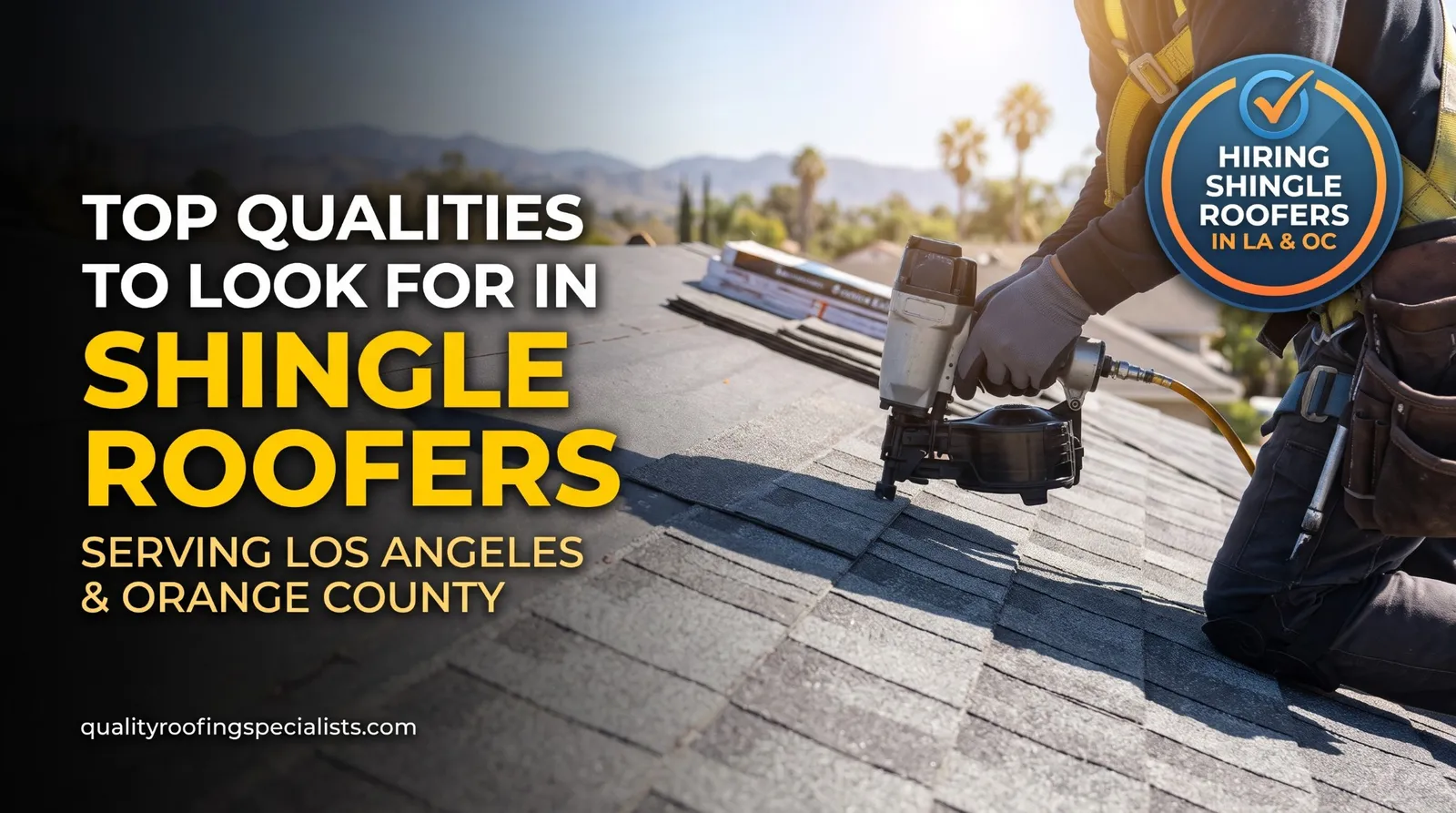
The qualities to look for in shingle roofers are straightforward: a roofer-led inspection with photos, a written scope and price before any work starts, a California license and insurance you can verify yourself, and warranties in writing. In Los Angeles and Orange County, finding shingle roofers who actually meet all four usually takes more than a quick search and a handful of quotes.
We are shingle roofers ourselves, so this guide is written from the roof: what your shingles are likely made of, what Southern California’s sun and wind do to them, how to tell a repair from a replacement, and what to require from any contractor, including us, before a single nail goes in. For the questions to ask at the estimate, see our companion guide on how to choose a shingle roofer in Los Angeles.
Key Takeaways
- A roofer looks first. Expect a roofer, not a salesperson, on your roof, and photos (drone footage where it helps) of what they found before anyone prices the job.
- The scope is written before you sign. It names the materials and covers the tear-off, deck, underlayment, flashings and ventilation, with a clear way to handle surprises.
- You verify the credentials yourself. Look up the license on the CSLB website and confirm the insurance with the insurer directly.
- Two warranties, both in writing. The manufacturer covers the shingles; the contractor’s workmanship warranty covers the installation.
- The red flags are specific: no license number on request, a large payment up front, an offer to waive your deductible or pressure to sign today.
Know What Kind of Shingles You Have
Most shingle roofs in Southern California are one of two kinds of asphalt shingle. 3-tab shingles are thin, flat and uniform, the older and more basic option. Architectural shingles (also called dimensional or laminate) are thicker, layered and textured, and they are what most homes here have been reroofed with in recent decades. You may also see composite or synthetic shingles made from polymer blends. Our comparison of architectural vs. 3-tab shingles shows the difference side by side.
Knowing which you have tells a lot about what to expect, but how long a shingle roof lasts here depends more on its exposure, its ventilation and how well it was installed than on the label. The warranty term printed on a shingle bundle is a coverage term for manufacturing defects, not a promise of how long the roof will last, and it doesn’t cover a poor installation, poor attic ventilation, storm damage or normal aging. That’s why the contractor’s own workmanship warranty matters, and why you should ask for both documents in writing, not just the term in the ad.
What Southern California’s Climate Does to Shingles
Los Angeles and Orange County are hard on a shingle roof. Strong sun and long dry seasons break down the asphalt that holds the granules, and heat speeds that up, leaving shingles harder, drier and more brittle. South- and west-facing slopes take the most sun, so one roof can age unevenly, with one side shedding granules while the other still looks fine. A lot of grit at the downspouts is often the first sign; our article on shingle granules in the gutter explains what a little and a lot mean.
Then there are the Santa Ana winds. Strong gusts lift shingle tabs, crack brittle edges and loosen flashings, and when winter storms follow, rain can be driven under the lifted edges instead of running off. A lifted tab can settle back down with its seal broken, so the damage isn’t visible from the street until the next storm finds it. A careful shingle roofer in this region checks the flashings, ridge caps and underlayment, not just how the shingles look from the ground.
Repair or Replace: Reading the Signs
Not every shingle problem needs a new roof. A few missing or lifted shingles after a windy night, one leak at a flashing or pipe boot, or a handful of cracked shingles on an otherwise sound roof are good candidates for a shingle roof repair. What makes a repair the right call is the rest of the roof: shingles that are still flexible, granules covering most of the surface, and no soft spots or sagging in the deck.
Replacement makes more sense when the wear is widespread rather than in one spot:
- Curling, cupping or brittle shingles across several slopes
- Bald patches and heavy granule loss
- Leaks that keep coming back after repairs
- A wavy roofline, or soft spots in the deck
- Moisture, mold, damp insulation or daylight through the sheathing in the attic
These are signs to look for, not a formula. A roofer needs to see the deck, underlayment, ventilation and flashings in person before the recommendation is final. If you’re chasing a leak now, our guide on how to find a roof leak walks through tracing one.
What a Real Shingle Roof Inspection Covers
Some contractors call a few minutes in the driveway and a number from a calculator an “estimate.” That isn’t an inspection, and it can miss a soft deck, failed underlayment or broken flashing seals that only show up once the old roof comes off. A real inspection is led by a roofer and looks at:
- The shingles on every slope, ridge and edge
- Flashing at every wall, chimney, skylight and pipe
- Valleys and the ridge caps
- Signs of a soft or damaged deck
- The underlayment, where it can be seen
- Attic ventilation, at the eaves and the ridge
Drone footage has changed what a thorough look can show. Photos from above cover every slope and flashing without walking on a roof that may be fragile, and they give you a record of what the roof looked like before any work started. Our roof inspection checklist goes through the points one by one.
After the inspection, the written scope should name the problem or the work, every material by brand and product line, the tear-off, how damaged decking will be handled and priced, the flashings, underlayment and ventilation, cleanup, who pulls the permit, and the manufacturer and workmanship warranties. A single lump-sum number with none of that gives you nothing to compare and no one to hold to it.
What Moves the Price of a Shingle Roof
We don’t publish prices in our articles, because the honest answer depends on your roof. What moves the number in Los Angeles and Orange County: the roof’s size and pitch, how many stories it sits above the ground, how many old layers come off, damaged decking found during tear-off, flashing work at chimneys, walls and skylights, ventilation the roof needs, and disposal. Two bids that differ a lot usually differ in what they include, which is why the written scope matters more than the total.
On a shingle roof replacement we install our TotalShield® Shingle System, every layer from the deck up: decking where it’s needed, underlayment, flashings, vents and architectural shingles, with the full scope and price in writing before any work starts. Hold any contractor to that same standard.
Credentials and Warranties to Require
In California, a roofing contractor needs an active license from the Contractors State License Board. Ask for the license number and look it up yourself on the CSLB website: check that it matches the business name on the contract, that it is active and carries a roofing classification, and whether it shows any disciplinary actions. Then ask for a certificate of insurance and confirm it with the insurer, using contact details you find yourself, for general liability and workers’ compensation through the end of your project. Workers’ compensation matters: if an uninsured worker is hurt on your property, it can become your problem.
What a Strong Warranty Looks Like
There are two warranties on a shingle roof. The manufacturer’s warranty covers defects in the shingles and other materials. The contractor’s workmanship warranty covers the installation itself, and it should say in writing what is covered and how to make a claim. Our roof warranties explained article goes through both.
For our part: Quality Roofing Specialists is licensed, bonded and insured (CSLB #1061942), accredited by the BBB with an A+ rating, and our installs carry a 10-year workmanship warranty (call for details), alongside the manufacturer’s warranty on the materials. You can see the details on our credentials page.
Red Flags
- No license number when you ask, or documents you can’t verify
- A large payment demanded before work starts
- An offer to waive or “cover” your insurance deductible
- A knock on the door after a storm and pressure to sign the same day
- A price with no written scope behind it
Frequently Asked Questions
What are the most important qualities to look for in shingle roofers?
A roofer-led inspection with photos, a written scope and price before any work, a California license and insurance you can verify yourself, and both the manufacturer’s and the contractor’s workmanship warranty in writing.
Should a roofer offer to waive my insurance deductible after storm damage?
No. An offer to waive or cover your deductible is a red flag. Pay your deductible as your policy requires, and expect the roofer’s photos and written scope to support your claim. Our guide to roof insurance claims in California explains the process.
How do I verify a shingle roofer’s license and insurance?
Look up the license number on the CSLB website and check the name, status, classification and any actions against it. Then call the insurance company, using contact details you find yourself, to confirm the general liability and workers’ compensation coverage.
What payment protections should I ask for?
Get the inspection, the photos and the written scope and price before you pay anything, and the warranty documents in writing. Walk away from anyone who demands a large payment up front or pressures you to sign the same day.
How do I compare bids from different shingle roofers?
Compare what each bid includes, not just the total: the named materials, the tear-off, how decking is handled, the flashings, underlayment and ventilation, the permit, cleanup, how changes are handled and the warranties. A bid based on a roofer’s inspection and photos gives you something real to compare.
Do you offer a free shingle roof evaluation?
Yes, for homes. A roofer from our team looks at your roof, with drone footage of the areas of concern, and you get photos, plain-English findings and a clear next step, then a written scope and price before any work. Book your free roof evaluation.
Start With a Roofer Who Shows You the Roof
Finding good shingle roofers in Los Angeles and Orange County isn’t about the lowest bid. It’s about a roofer who looks first, documents what they find, puts the full scope in writing before any money changes hands and backs the work with a warranty in writing. The Southern California climate is hard on shingle roofs, and the right roofer accounts for that from the inspection on.
We offer a free roofer-led evaluation for homes, with drone footage and written findings, as the start of every shingle roofing project. Hold any other contractor you consider to the same standard. Part of our asphalt shingle roof guide.
